
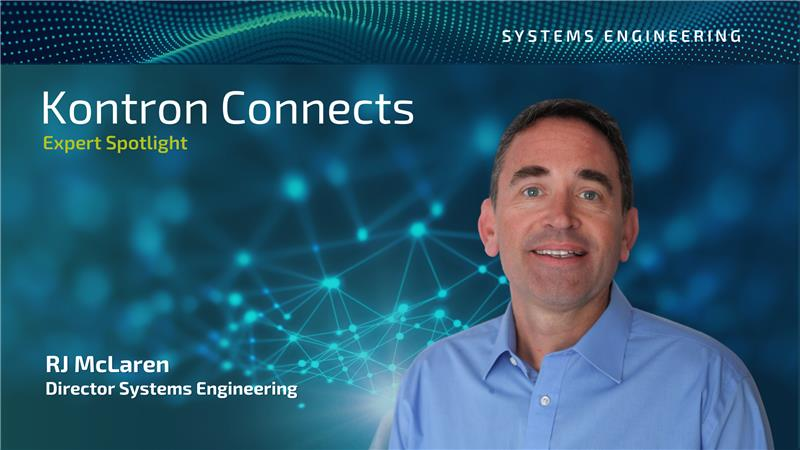
Welcome to Kontron Connects, your gateway to unlocking industry insights directly from our experts. Dive into our new series and gain a competitive edge as we provide an in-depth analysis of industry trends and invaluable expertise tailored to your success.
Ever wonder how mission-critical technology survives the harshest of conditions? I recently sat down with RJ McLaren, Kontron’s Director of Systems Engineering, and it was immediately clear why he’s at the helm of one of our most critical technical teams. With a background in engineering and a master’s in business administration, RJ brings both deep technical expertise and strategic vision to the table. He leads the North American systems technical group—including ITAR systems—which is responsible for designing and delivering rugged embedded systems that power mission-critical operations in defense, aerospace, and transportation.
What particularly stood out in our conversation was his ability to articulate how our engineering efforts go far beyond assembling components. These systems are carefully crafted to perform in environments where commercial technology simply can’t survive—from high altitudes and moving vehicles to extreme temperatures and vibration.
Tania: I understand you work with modular tech like COM Express (COMe) and VPX. How do those become full systems at Kontron?
RJ: We use these Kontron board level building blocks to create fully integrated, application-specific systems that can then be tailored to each customer’s needs. It’s not just about putting parts together. Every system we design is carefully configured, rigorously tested, and certified to handle the real-world conditions it’s going into.
Environments that are constantly in motion
We work with platforms that are constantly in motion—aircraft, naval vessels, ground vehicles—where systems are exposed to continuous vibration & shock, temperature extremes, fluids, and electromagnetic interference. You can’t just take commercial equipment, put it in a rugged case, and expect it to perform. We design our platforms for mission-critical reliability in those environments. That’s what makes the difference.
Tania: Is performance your biggest concern?
RJ: When it comes to deploying technology on moving platforms—especially in aviation for example—performance isn’t the only concern. Safety and compliance are critical, and meeting strict certification standards is non-negotiable. This is why off-the-shelf solutions simply don’t cut it when safety is on the line.
Tania: So, you can’t just use something like a home Wi-Fi router on an aircraft to enable connectivity for example?
RJ: Unfortunately not - design control, verification, and certification are some reasons why. Any system going into a moving platform—especially an aircraft—has to be fully controlled and documented down to the component level, then tested and proven safe. A consumer-grade Wi-Fi router isn’t built for that and doesn’t have the part control or design metrics in place. For example, it can emit frequencies that can interfere with critical systems like flight controls, radar, or obstacle detection.
Ruggedness and safety are the key
Every application comes with specific environmental standards, EMI/EMC testing, and strict safety requirements. We make sure our solutions are designed and validated to meet all those needs.
Tania: How much does the environment influence system design?
RJ: The environment dictates everything. Whether it's extreme altitude, harsh temperatures, or surviving shock, vibration, and lightning strikes—those factors drive every design choice we make. We have to balance SWaP: size, weight, and power—especially when customers want more performance in smaller footprints, with lower energy consumption.
We choose to start with the environment
We ask ourselves what vehicle is it going on, where is it being installed and the type of application. Is the vehicle an aircraft, an unmanned drone, tracked vehicle, a ship? Each type of vehicle has its own kind of power system that we need to connect to and ensure proper operation. Once we know these things, we can start from the right system platform and configure it accordingly. The core computing technology might be similar across projects, but how we package and integrate it is what makes each solution successful in its specific mission.
Tania: With new technologies constantly emerging, how does your team stay ahead?
RJ: We’re not inventing the chips or devices—but we are making them usable in rugged environments. Whether it’s GPUs, 5G radios, or the latest x86 or ARM processors, our job is to figure out how they fit into our platforms and how to make them work reliably under extreme conditions.
Technically, it involves a lot of work. We design systems that can properly interface with those components, manage heat, handle power constraints, and maintain stability in harsh conditions. It’s all about taking cutting-edge tech and making it mission-ready for defense and industrial markets.
Tania: Do you have a favorite product that you’ve designed?
RJ: My favorite has to be our rugged carrier board we built to support COMe modules. At the time, the goal was to design a single carrier that could work across many different target markets and include standard expansion slots for modularity at the system level. We wanted to prove that this kind of cross-market flexibility in a highly rugged design was possible—and we did.
What’s really special about this solution is that it laid the foundation for so many of the different platform products we have today. It was engineered from the start to meet the needs of vastly different environments—small form factor mission computers for defense, rugged agriculture and mining vehicles, commercial and government service vehicles, maritime, and avionics systems. Instead of building a ground up custom solution for each use case, we designed a highly compact, modular and rugged system platform approach that could do it all. And it worked.
Tania: That’s impressive. What made it so successful?
RJ: Its simplicity and reusability. Most people build carrier boards for one specific application. But every time you develop a new solution, you introduce the possibility of failure. By sticking to a proven reliable, rugged design, we significantly reduce that risk. We’ve shipped thousands of configured systems with confidence, knowing they perform consistently.
And it’s not just about the hardware itself—it led to a broader strategy. Out of that effort came what we call the Signal Interface Board, or SIB. It’s part of a methodology that enables the flexibility to match the customer specific external connectors and signaling required for that vehicle application and include any unique feature requirements. It provides a low-risk customization feature to build on top of our core technology with our customers or partners to meet the exact mission profile requirements. This translates to faster development times and reduced costs for our customers.
It’s more than just a board, it’s a framework
One can think of it as a platform strategy as much as a product. It provides a reliable framework for tailoring a solution for the specific application in a highly efficient manner. This gives our customers a faster-time-to-market approach with the least amount of risk and resources required to get there. We leverage our proven foundation, and scale more efficiently.
In the end, it has helped create multiple programs wins in a wide range of applications. It’s simple, maybe not always visible to the customer, but it’s critical to everything we do. I never would’ve imagined all the things we’d end up building on top of it.
Tania: Can you give an example of how rugged design and modularity come together in your work?
RJ: Kontron’s 901 rugged mission computer is a great example. We built it on a modular, standards-based COMe architecture with various expansion capabilities, which gives us the flexibility to adapt it to different customer needs. But the key is—it’s designed to perform in harsh, mobile environments. The base system meets our customers' primary needs for a rugged compute platform and then a vehicle-specific data bus like CANbus, MIL-STD-1553, or ARINC 429 can be included to give it an additional interface aligned to the vehicle architecture.
It brings mobile compute performance to the edge, but in a way that can handle vibration, temperature extremes, and unpredictable conditions. We standardized it as a flexible platform that works across a wide range of use cases, which isn’t easy when you're dealing with such a diverse set of rugged environments.
Tania: Looking ahead, where do you see system architecture going soon?
RJ: It’s clear that artificial intelligence (AI) is going to play a huge role at all levels. We are not only seeing the demand for AI features in the systems we are building, we are also able to use it to optimize our own workflow in designing these systems. AI tools are expanding how we work across different engineering disciplines, and that trend is only going to grow. Traditionally, something like creating documentation would take a lot of time—now, with the right AI support, much of that can be streamlined with a digital assistant. That means faster time to market, lower costs and a gentler learning curve for teams picking up new technologies.
AI isn’t just changing what we build—it’s changing how we build
Every company is investing in AI right now, which means the cost of entry is dropping, and people can get up to speed faster. From a systems perspective, that’s a game-changer. AI will help us streamline all aspects of our workflow—from documentation and training to how we break down complex problems and design new systems.
Tania: How does that impact your team and how you approach architecture?
RJ: It means we’ll be able to do more with fewer resources. That’s critical in embedded systems, where timelines and constraints are tight. By leveraging AI across the system side, we can shorten development cycles and build more capable, intelligent products without scaling our teams endlessly. It’s about working smarter, not harder—and AI is going to be a key enabler for that.
If you'd like to speak to us directly about any current challenges, or your next project, we're happy to help. Contact us at [email protected].
About RJ

RJ McLaren is the Director of Systems Engineering at Kontron for the North American team, bringing over 25 years of experience in the embedded computing industry. His core focus is to strategically align and develop system products in accordance with industry standards and emerging technologies and plays a key role in understanding and communicating these technology trends to customers and shaping Kontron’s next-generation system product roadmaps to meet evolving market demands. He holds a Bachelor’s Degree in Engineering and a Master’s in Business Administration from NNU.


{{comment.comment}}