
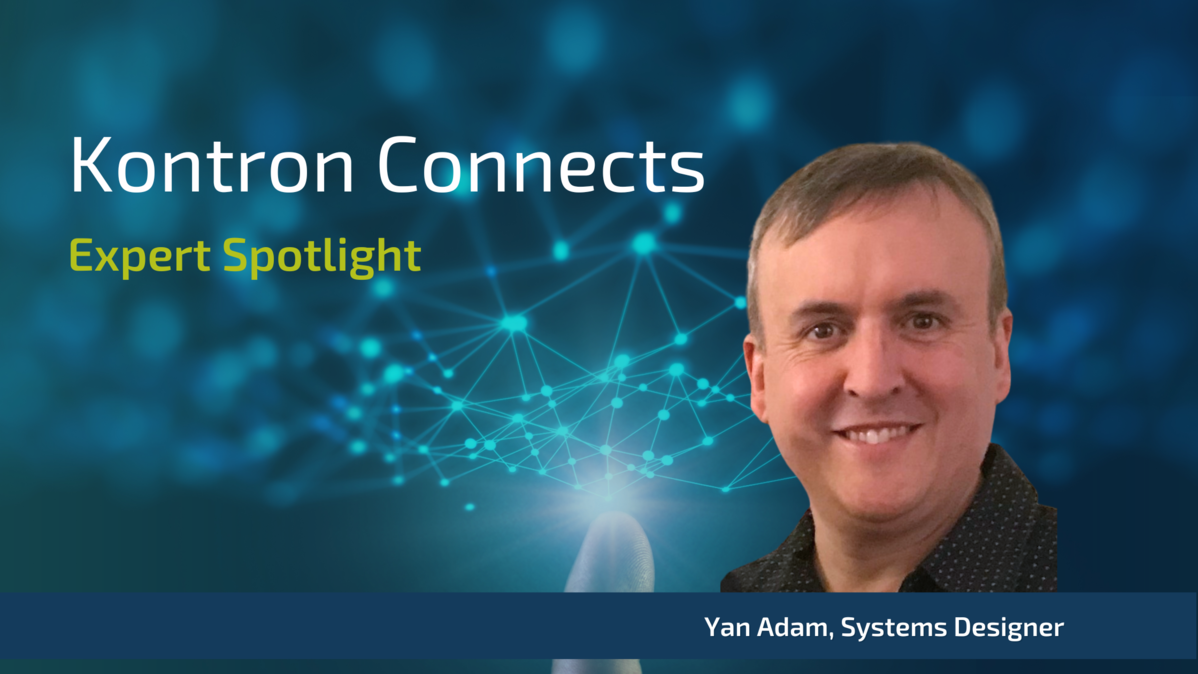
Welcome to Kontron Connects, your gateway to unlocking industry insights directly from our experts. Dive into our new series and gain a competitive edge as we provide an in-depth analysis of industry trends and invaluable expertise tailored to your success.
When you’ve been with a company for 30 years, you don’t just know the products—you understand the market, the technology, and where it’s headed. With three decades at Kontron and a background in electrical engineering, Yan Adam is far more than a systems engineer—he’s a subject matter expert in networking and a long-time observer of how the telco market has evolved.
I had the chance to sit down with Yan to dive into what’s driving change at the edge, why AMD processors are now part of Kontron’s portfolio, and how details like airflow, noise, and integrated networking are playing surprising roles in shaping next-gen compute platforms.
Tania: 30 years at Kontron is impressive! I imagine your role has shifted quite a bit—what does your day-to-day look like now?
Yan: Currently I manage Kontron’s Communications and Connectivity line of products, including the CG, ME and RS series, and know the ins and outs of networking very well. That means helping customers not only deploy rugged compute systems but also integrate networking features like switches and BMCs into their environments.
Tania: How has the communications market evolved since Kontron introduced the first of the ME series, the ME1100?
Yan: When we launched the ME1100, our focus was on the telco edge—specifically, far-edge deployments for mobile service providers. But over time, larger server manufacturers reclaimed that edge compute back to the core, and that shrunk the addressable market for us. The opportunity wasn’t exactly the same.
Private networks
Where we’ve found real traction is in private cellular networks. These smaller-scale deployments don’t have the same level of infrastructure between the cell sites and the core, so customers can’t easily centralize their compute. That’s where we come in—our rugged, compact compute boxes are a natural fit for far-edge deployments where real-time data handling is needed right at the source.
Tania: Interesting. Any real-world examples you can share?
Yan: Sure. One great example is how we are working on a private 5G deployment for the Grand Paris L18 Express railway. We currently have several ME1210 platforms installed along the railway enabling trains to communicate with one another. That type of use case—RAN compute, precision timing, PTP sync—is exactly what our ME platform is built for.
Another project worth mentioning is actually outside the cellular space—we’ve partnered with a customer deploying Content Delivery Networks (CDNs). They needed compact, rugged systems to localize content storage in rural and remote areas. We were able to integrate storage as well as meet their environmental requirements with a small-footprint, high-performance compute/storage box.
Tania: You mentioned earlier that private cellular networks are a better fit for Kontron than traditional telco. Why is that, and what advantages do private networks offer?
Yan: Private cellular networks are typically smaller, localized deployments—like a factory floor, a campus, or a remote industrial site. The big advantage is control. Companies can manage their own coverage, performance, and security instead of relying on public mobile networks.
Bringing compute power at the site
They also usually don’t have the infrastructure to send all their data back to a centralized core like the big carriers do. That’s why edge computing becomes essential—they need the compute power right at the site, where decisions are being made and data is being generated. That’s where our rugged, compact systems really shine. We give them the ability to analyze data, apply AI, or run applications right at the edge without needing to pipe everything to a distant cloud or data center.
It’s a constantly growing space, and we’re seeing more customers interested in setting up these kinds of networks—especially in transportation, energy, and manufacturing.
Tania: You recently added AMD processor support to your platforms. What does that unlock?
Yan: Yes, this is a big step forward for us. Historically, we’ve only used Intel CPUs and designed our own motherboards. But with the new CG2500 server for example, we’ve added AMD processor support using a third-party motherboard. That opens up more choice for developers, better core counts, and cost-effective performance—especially attractive to industries like medical where they have lots of data to analyze. Integrating GPUs for AI driven data analysis is also key in this market.
Why AMD processors
Sometimes the decision just comes down to company culture or budget. Some customers need more cores at lower costs, and AMD delivers that. Having both options means we can meet a broader set of customer needs.
Tania: Let’s talk airflow and noise level. Sounds niche, but you’ve made a point of improving it. Why?
Yan: Absolutely—it’s not just about performance, but where the systems are used. In DNA sequencing labs, for example, technicians are sitting next to large equipment cabinets all day. Our CG2500 platform is part of that stack, along with other equipment.
The quietest server on the market
If our systems ran full-speed fans all day, the noise would be disruptive. We designed our airflow to direct cooling where it matters most—CPU, GPU, power devices—rather than just blasting air through the whole chassis. That means we get better thermal performance with lower noise. It’s a small change, but it really matters in real-world environments.
Tania: You mentioned your work as a networking expert. How does that show up in Kontron’s products?
Yan: A lot of our systems now include integrated Ethernet switches, especially where space is tight—like avionics. Think of a system with multiple internal devices: the COMe, BMC, maybe a secondary processor. Instead of routing everything through separate physical ports, we use embedded switches in our systems to interconnect devices inside the box.
Less equipment needed for IFEC
This makes our systems compact and cost-efficient. In inflight entertainment and connectivity (IFEC), for example, our servers often act as the central node managing the cabin wireless access points (CWAPs). Instead of requiring a separate external switch, we bake that function right into the platform. It’s more efficient, both in terms of cost and space—which is crucial in aircraft where space is limited.
Tania: And how do you bridge software and hardware when customers need more custom networking features?
Yan: That’s where my systems engineering background helps. Customers often need firmware-level configuration—for switches or baseboard management controllers (BMCs). I work with our software development teams to translate customer needs into technical solutions, prioritize features, and make sure everything integrates smoothly.
At the end of the day, understanding both the hardware and the software is key. It lets me debug systems more effectively and guide customers on how to configure their platforms for the best performance.
Tania: It sounds like your work touches everything from airflow design to networking and system integration. What’s the common thread that ties it all together?
Yan: For me, it’s all about making sure our systems are adaptable to where and how they’re used. Whether it's helping deliver compute at the far edge for a 5G railway, optimizing airflow for a genomics lab, or integrating switches into space-constrained avionics systems, the goal is the same—make the technology work smarter, cooler, and quieter.
That means looking at the big picture—how hardware and software interact, what real environments demand, and what customers actually need to solve their challenges. It’s a blend of engineering, problem solving, and a lot of listening to the end customer.
About Yan

Yan Adam leads systems design for Kontron’s Communications and Connectivity product line from the company’s Montreal, Canada office. Working on electronics and integration of generations of Communications products at Kontron also leads to serving as the go-to expert in networking. With an engineering background and over 30 years at Kontron, he is a seasoned design leader known for his customer centric vision and deep technical expertise. Yan holds a Bachelor’s of Electrical Engineering from Sherbrooke University in Quebec, Canada.


{{comment.comment}}