

Migration plans must ensure minimal disruption to operations to maintain service continuity.
The future of rail is digital: Increasing volumes of data, the automation of train operations, and unprecedented security requirements call for a 5G-based system with high bandwidth, advanced end-to-end encryption, and support for ultra-reliable, low-latency communication. Our deep industry expertise and a portfolio of tailor-made end-to-end solutions make us the #1 partner for railway operators during their transition to FRMCS.
A Partner for Every Migration Challenge
Kontron Transportation is ready to guide railway operators through every stage of the FRMCS transition. Our migration strategy reduces complexity, lowers deployment costs, and provides a practical roadmap from today’s GSM-R networks to tomorrow’s fully digital FRMCS environment.
Benefit from Our Experience
Uninterrupted operations through a phased migration approach
Seamless coexistence between legacy systems and next-gen services
Protection of existing investments through infrastructure reuse
Deep expertise in GSM-R, FRMCS, and mission-critical communications
Proven delivery capabilities for large-scale modernization projects
Reduced risk through a carefully planned, step-by-step migration strategy
The Kontron Migration Strategy
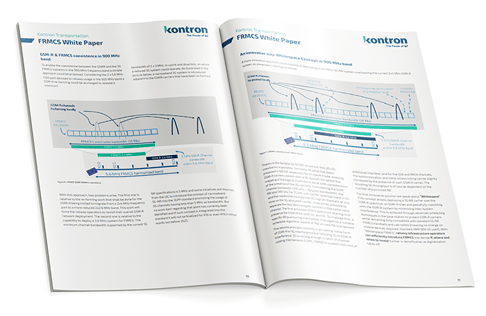
As your end-to-end migration partner, we guide you through a phased transition in which GSM-R and FRMCS operate side by side. Our innovative White Space approach allows FRMCS services to be introduced within the existing railway spectrum while preserving GSM-R operations, so you can leverage current sites and infrastructure.
End-to-End Communication Solutions from the Global Industry Leader
Kontron Transportation is a leading system integrator backed by a wide partner network and unparalleled railway industry expertise. Our engineers played a pioneering role in the rollout of GSM-R, and today, we’re at the forefront of shaping the future with FRMCS standardization. With our dedication to railways, we deliver solutions that set new benchmarks for quality and security in mission-critical networks.
GSM-R
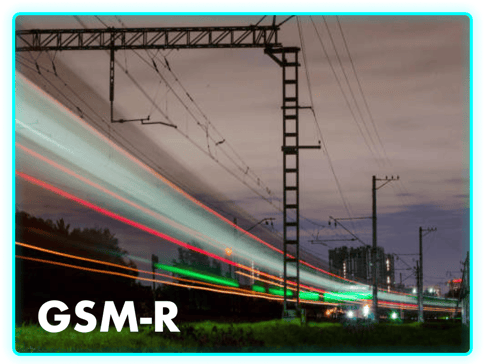
Our communication solutions support the entire range of EIRENE requirements for railway voice and data communication, with guaranteed performance at speeds exceeding 500 km/h (310 mph).
5G FRMCS
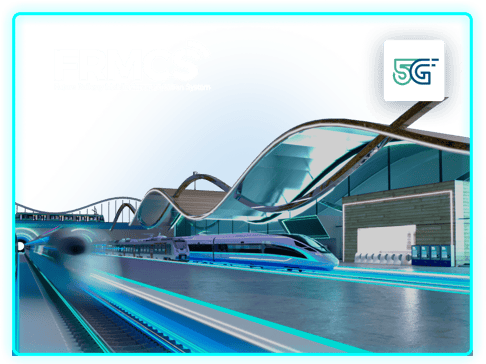
With railway-dedicated 5G access and core, our FRMCS technology supports new services and enables secure applications with higher performance, flexibility, and availability than ever before.
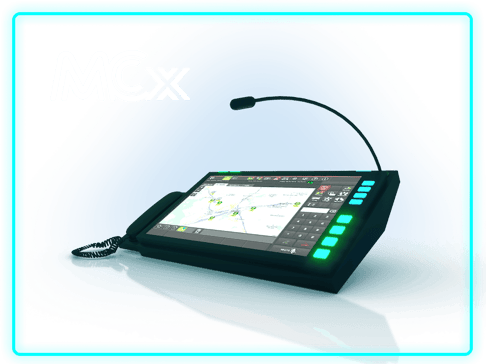
MCx
Based on the FRMCS standardization (3GPP, ETSI), MCx is the integral service control subsystem supporting functions that replace GSM-R equivalent features such as point-to-point or private calls, group calls, and rail emergency calls.
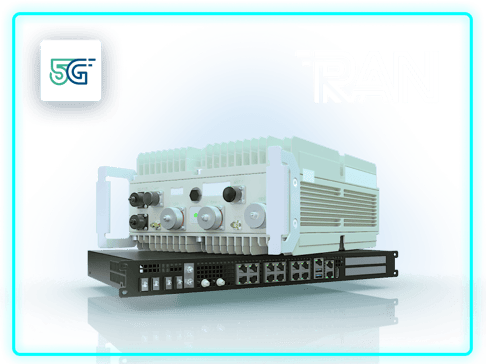
5G RAN
Designed for mission-critical networks that operate under extreme conditions, our 5G-based Radio Access Network is reliable, robust, and ready for the future. It offers a key enabler called White Space for the transition phase from GSM-R to FRMCS, which allows efficient coexistence and concurrent usage of the 900Mhz frequency range.
The Kontron Advantage: Key FRMCS-Ready Capabilities
Full Compliance with FRMCS Standards
Full Compliance with FRMCS Standards
Smooth Interworking Between GSM‑R and FRMCS
Smooth Interworking Between GSM‑R and FRMCS
Innovative Whitespace Concept
Innovative Whitespace Concept
Complete End‑to‑End Solution
Complete End‑to‑End Solution
Frequently Asked Questions
What does the migration from GSM-R to FRMCS actually involve?
Migrating to FRMCS is not a simple technology replacement. It is a step-by-step transformation of the railway communication ecosystem.
The transition encompasses radio networks, mission-critical communication services, onboard equipment, operational applications such as ETCS, and railway control center systems. Because GSM-R will remain operational for years, railway operators need a migration strategy that allows both technologies to coexist while ensuring uninterrupted operations.
Kontron Transportation’s approach enables operators to introduce FRMCS gradually, migrate services at their own pace, and maintain seamless communication between GSM-R and FRMCS users throughout the transition period.
Do I need to shut down GSM-R before I can deploy FRMCS?
No. In fact, we recommend running GSM-R and FRMCS in parallel throughout the migration period. Our migration strategy is designed to allow a gradual transition, enabling GSM-R users and FRMCS users to communicate with each other through dedicated interworking functions (IWF). This means operators can migrate user groups, services, lines, or regions step by step rather than performing a risky “big bang” switchover.
Can I reuse my existing GSM-R infrastructure for FRMCS?
Yes. Reusing existing GSM-R assets is a central element of our migration strategy. By deploying FRMCS on existing GSM-R radio sites, we enable operators to leverage current infrastructure and significantly reduce deployment costs.
Through our innovative White Space concept, a 5G NR FRMCS layer can be introduced in the 900 MHz railway spectrum while preserving ongoing GSM-R operations. This enables operators to begin their FRMCS rollout immediately, without waiting for a complete network redesign or extensive new site construction.
How can GSM-R and FRMCS operate in the same 900 MHz spectrum?
We address this challenge through our White Space approach. Instead of splitting the railway spectrum between GSM-R and FRMCS, a 5G carrier can be overlaid on the existing GSM-R spectrum. Advanced scheduling mechanisms protect GSM-R carriers while allowing FRMCS traffic to use the remaining radio resources.
The key benefit is that GSM-R performance remains protected while FRMCS services become available on the same infrastructure. Standard FRMCS devices can use this solution without requiring modifications, making it a practical and cost-effective migration path.
When do I need to deploy the new 1900 MHz FRMCS spectrum?
Not necessarily immediately. We recommend introducing the 1900 MHz layer only where additional capacity or higher traffic density actually requires it.
The migration starts with FRMCS over 900 MHz, using existing GSM-R sites. The 1900 MHz layer can then be added selectively in high-demand areas such as major stations, dense urban sections, freight hubs, or shunting yards. This targeted densification strategy avoids large upfront investments and allows capacity to grow alongside operational needs.