
When AI Joins the Inspection: How Kontron AI Vision Automates Visual Inspection
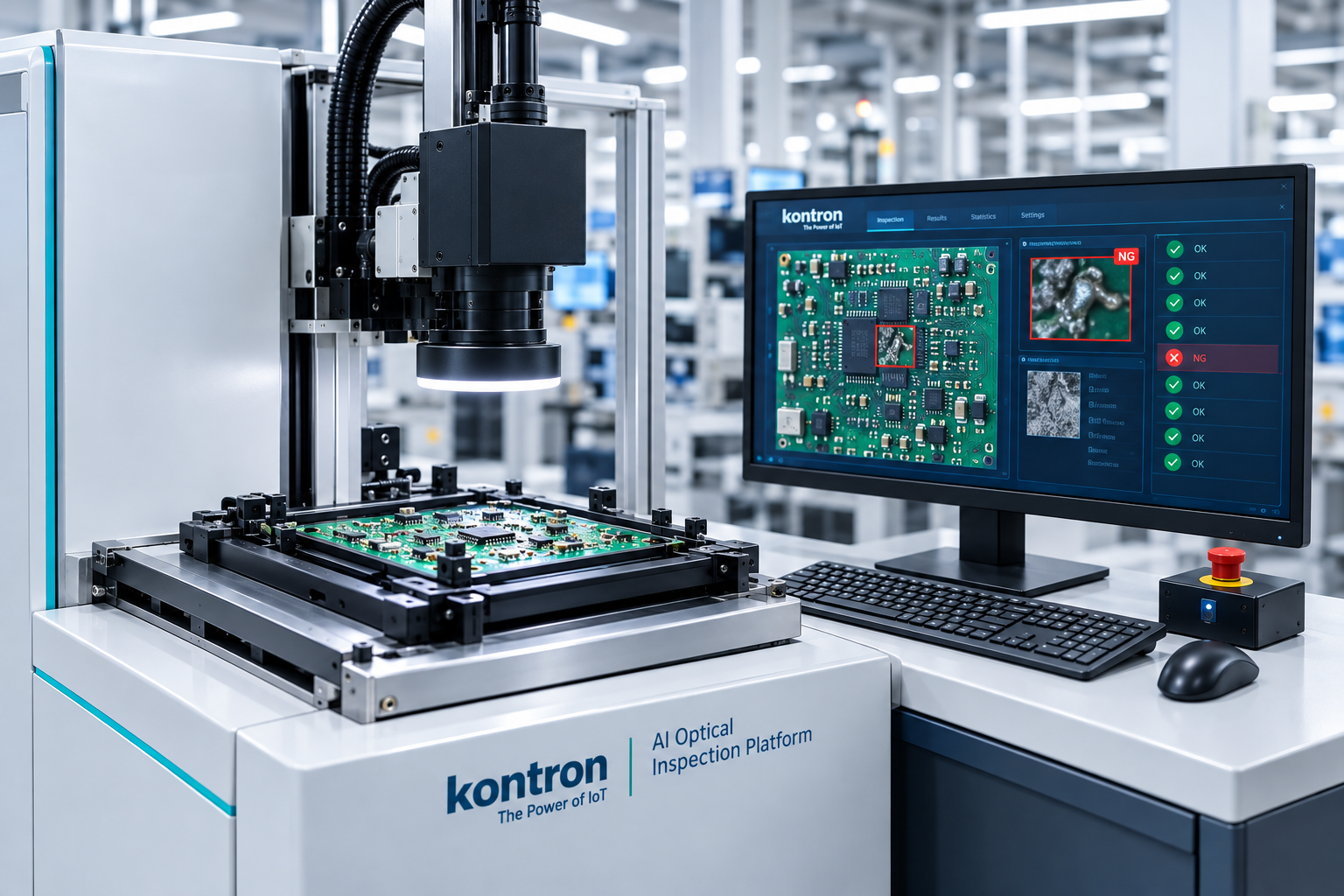
Following SMT and THT assembly, many manufacturing and assembly processes still require manual visual inspections. Kontron VisionAI Framework was developed to automate these inspection tasks using artificial intelligence - even for frequently changing product variants. In this interview, Jochen Gimple (VP Production & Operations Kontron Global) explains the solution approach, how AI and image acquisition work together, and the challenges involved in implementation.
What is the idea behind Kontron VisionAI Framework, the AI-powered optical inspection platform?
Jochen Gimple: The idea was to make quality inspections cost-effective, objective, and scalable. To achieve this, we combine modern AI technologies with conventional image processing to detect defects reliably and in real time.
Unlike conventional inspection methods, the system can flexibly inspect complex products with many variants without requiring time-consuming creation of new inspection rules for every change. The solution enables automated inspection processes and consistently higher inspection quality.
What challenges did quality inspection face in your own electronics manufacturing operations, and how did these lead to the solution approach?
Jochen Gimple: The key challenge arose from the requirements of our own electronics manufacturing operations: As a high-mix manufacturer, we produce a wide range of product variants. Our quality inspection process therefore needs to be equally flexible.
Our analysis of available market solutions showed that many AI-based inspection systems require extensive training before they can be used in production. However, this approach is only practical to a limited extent in manufacturing environments with frequently changing products, because the training effort is often disproportionate to the respective production volume.
We therefore chose an approach that can be used productively from a batch size of one without a lengthy training phase. The platform was designed to learn during operation and continuously expand its knowledge. This allows new products and variants to be integrated into the inspection process without extensive preparatory work.
How do image acquisition, AI, and the KBox work together when inspecting an assembly?
Jochen Gimple: The solution combines camera-based image acquisition and artificial intelligence with our new Intel-based KBox A-151-PTL-ROBO. It provides the required computing power directly on the production floor. First, cameras capture images of the assembly to be inspected. Our AI model analyzes the images in real time and compares them with the target specifications. In doing so, it identifies deviations such as missing components, assembly errors, or cosmetic defects.
Processing takes place locally on the KBox and is therefore independent of cloud systems. The flexible, scalable solution can be integrated into existing manufacturing processes and adapted to different inspection tasks.
What challenges arose in image acquisition, and how did you resolve them?
Jochen Gimple: The project demonstrated just how significantly lighting affects inspection results. AI-based inspection also requires sufficiently high and consistent image quality to operate reliably. Reflections, shadows, and changing ambient conditions can make it more difficult to detect features and defects.
Through numerous tests, we coordinated image acquisition and lighting to achieve consistently high image quality even under real-world production conditions. The key factor is therefore not the software alone, but the interaction between AI, camera technology, and lighting.
In which manufacturing areas is the solution used, and how does it contribute to quality assurance?
Jochen Gimple: Our goal was not to replace established AOI systems for SMT or THT assembly. Our focus is on the downstream manufacturing and assembly processes that often still require manual visual inspections. In these areas, increasingly complex products and rising quality requirements are accompanied by significant cost pressure.
Kontron VisionAI Framework makes it possible to automate manual visual inspections in these areas. For example, it detects missing components, assembly errors, or cosmetic defects and enables manual visual inspections to be automated. Reproducible inspection results support quality assurance and can help reduce failure costs, rework, and customer complaints.
The aim is to relieve employees of tasks where AI can perform standardized visual inspections cost-effectively and reliably. This gives them more time for other value-adding activities.
Conclusion:
Thank you for the insights into the development of Kontron VisionAI Framework. The discussion shows that AI can support optical quality inspection even in downstream manufacturing and assembly processes that have previously required manual visual inspections. The key factor is the interaction between AI, image acquisition, and lighting.
We will demonstrate how this interplay works in practice at electronica in Munich from November 10 to 13, 2026. At our booth in Hall A1, Booth 449, we will present Kontron VisionAI Framework in a live demonstration and show the solution in practical use.