
Save Time, Reduce Costs: Why MOST Is the Key to Efficient Product Development
Solutions close to series production based on existing platforms are widely regarded as a key enabler for shorter development cycles and reduced risk. With MOST (Modified Standard Products), proven standard solutions can be specifically adapted to meet customer requirements – provided that the standard elements and the modifications are clearly separated and evaluated accordingly.
In the following expert interview, with Franz Ott (Business Development Manager at Kontron Electronics GmbH) we explain which parts of a MOST solution can be considered proven, where additional validation effort arises despite the platform approach, and what developers should pay particular attention to when it comes to planning, interfaces, testing, certification, and cost management.
If you had to explain MOST in one sentence: which part of the solution is “standard” and which is typically modified?
MOST stands for Modified Standard Products. The technical foundation is based on proven, production-ready standard platforms. These serve as a stable starting point and are selectively modified in areas where specific customer requirements demand adjustments.
In practical terms, this means that existing platforms or CPU-based systems are not developed from scratch, but deliberately reused. Modifications typically involve aspects such as memory expansion, interface configuration, mechanical adaptations, software scope, or certification and regulatory requirements. The goal is to change only those elements that provide real added value for the specific application.
Such modifications can be driven by various factors, including functional extensions or reductions, cost or supply chain optimization, as well as design adjustments to support high-volume production. At the same time, the core of the product is intentionally kept stable in order to minimize development, testing, and industrialization effort.
From your perspective, what information is essential to establish a realistic timeline and project plan?
The starting point is always a clearly defined product specification. This includes a well-defined scope of functionality, an understanding of the technical challenges involved, and a realistic assessment of the overall project complexity.
Equally important is detailed information about the intended operating environment. Factors such as temperature ranges, mechanical stress, or EMC requirements have a direct impact on component selection, layout design, test strategy, and validation effort. These parameters should be clearly defined at the beginning of the project to avoid costly adjustments later on.
Another key aspect is compliance with standards and regulatory requirements. These not only shape the development process itself but also influence testing procedures, documentation, and potential certification processes. In addition, the specification should be complemented by target volumes, cost objectives, and clearly defined milestones, as these factors have a significant impact on development, manufacturing strategy, and industrialization.
Where do you see the greatest efficiency gains with MOST? Which development and verification steps can be accelerated or partially avoided by leveraging existing platforms or components?
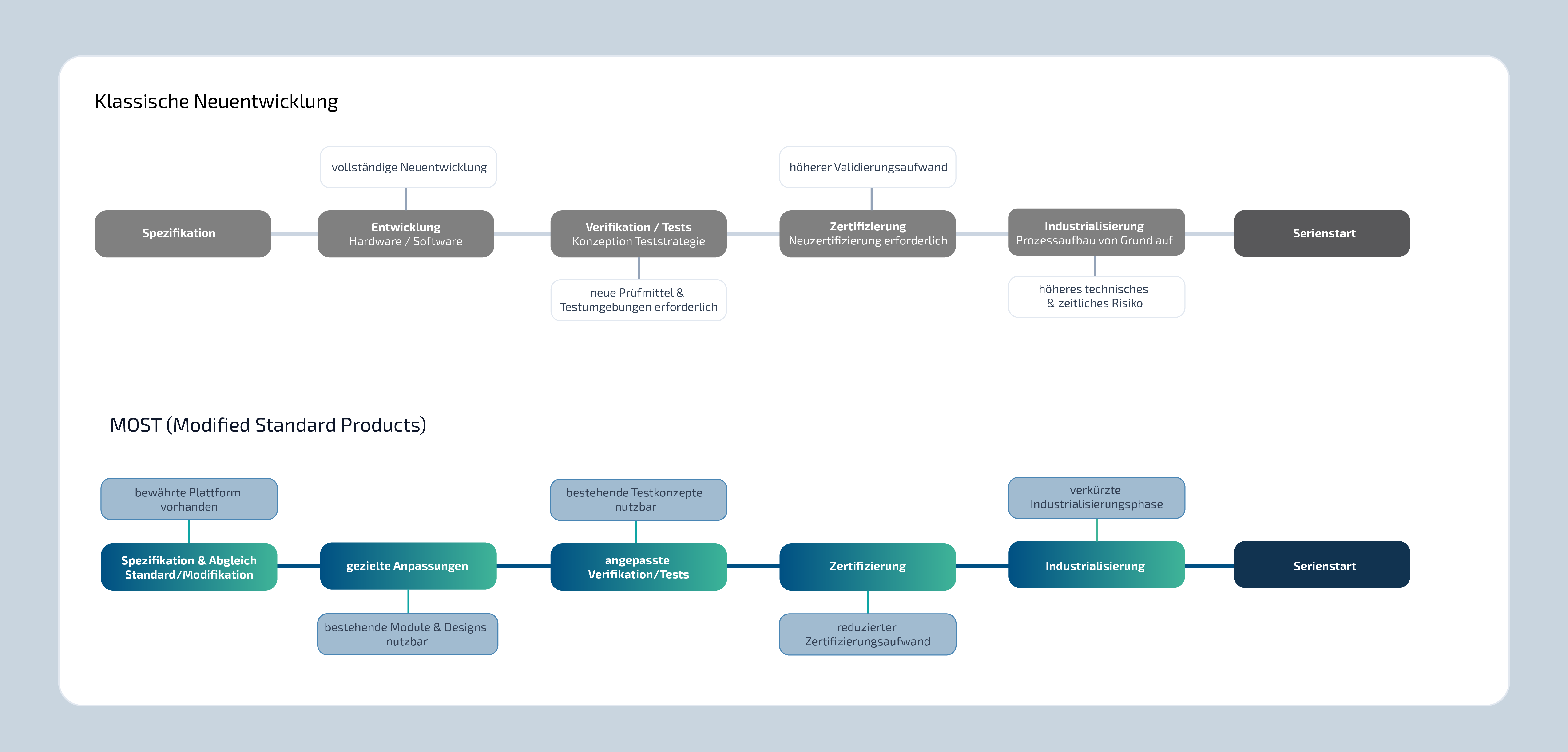
The most significant time savings come from the consistent reuse of proven functional modules. Instead of starting every project from scratch, we rely on established building blocks, validated hardware concepts, and mature platform architectures.
Additional gains are achieved through existing development and production processes. Test environments, manufacturing tools, and internal workflows are already in place, allowing many steps to run in parallel, be completed more quickly, or in some cases be eliminated altogether.
The platform approach also delivers clear advantages in production. Test setups often do not need to be developed from the ground up, as existing concepts can be reused or only slightly adapted. In addition, much of the traditional production briefing becomes unnecessary, since both the product and the underlying technology are already familiar.
Overall, MOST contributes to a significantly faster time-to-market while maintaining a high level of process reliability and consistency.
Close to series production does not mean production-ready. Which parts of a MOST solution are already proven? Which components should developers critically assess?
MOST is built on the principle of purposefully reusing what has already been proven. We do not view a MOST project as a complete new development, but rather as a combination of individual functional building blocks. Each of these blocks has already been validated and proven to perform reliably. The more of these elements are used in the target system, the less workload is required for development, testing, and industrialization.
This approach is further supported by the use of integrated modules, such as Systems-on-Module (SoMs). Proven CPU modules already offer a high level of maturity and significantly reduce development timelines.
In a MOST context, the following aspects are typically considered proven:
High functional reliability based on already deployed base products
Pre-qualified or verified EMC performance at module or platform level
Long-term available, production-ready CPU, module, and board platforms, including SoMs and evaluation boards.
Additional development effort arises whenever customer-specific requirements exceed the capabilities of the existing solution. This is often the case with challenging environmental conditions, specific interface configurations, thermal constraints, or complex system integration requirements.
MOST does not eliminate the need for technical validation—it strategically reduces it. Proven functionalities are carried over, while project-specific deviations are clearly identified, reassessed, and addressed in a transparent and structured manner.
How do you handle changes to interfaces, and in which areas can even small modifications have a significant impact?
MOST benefits from a broad portfolio of proven interfaces, ranging from classic I/O signals and fieldbus systems to advanced communication interfaces, wireless technologies, displays, and touch integration. Many of these functions can be adopted directly or adapted with relatively little effort.
At the same time, practical experience shows that seemingly minor changes can have far-reaching consequences. A protocol switch or a modification to the pinout, for example, may require additional testing, renewed validation, or EMC assessment, especially if the affected modules have already been validated.
Timing is therefore a critical factor. When interfaces are clearly defined and properly secured early in the project, subsequent adjustments can usually be integrated with minimal effort and without disrupting the overall development process.
Test strategy: Which tests can be reused, and where is redesign required when changes are introduced?
The test strategy in a MOST project is strongly built around reuse. Many development and verification tests can be carried over directly, as existing test equipment, adapters, and test concepts are already available. This allows a substantial reduction in effort, particularly in the early phases of the project.
MOST projects also benefit from established structures at the regulatory level. Pre-compliance testing, qualifications, or certifications from predecessor products can often be leveraged. New or adapted tests are only required where modifications make this technically necessary, for example, when introducing new components or adjusting measurement parameters.
The overall objective is to strike the right balance between test depth, development effort, and a practical, production-ready implementation.
Certifications & regulatory frameworks: Which compliance requirements have the greatest impact on the scope of a MOST project? And how do you avoid unintended certification implications when making modifications?
Certifications and regulatory requirements are becoming increasingly important in product development and account for a growing share of the overall effort. As a result, they play a major role in defining both the scope and structure of MOST projects.
Typical compliance areas include EMC, RED, and CE requirements, as well as industry-specific regulations such as MDR or ATEX. In addition, cybersecurity is gaining importance, particularly in the context of NIS2, as well as through operating systems and security frameworks such as KontronOS or AI Shield.
A key advantage of the MOST approach is that existing certifications can often be largely transferred, provided the customer-specific product remains technically and structurally close to the original platform. In this context, not only device functionality matters, but also aspects such as geometry, system design, and the integration of individual components.
Our goal is therefore to design products for certification from the very beginning. This means addressing relevant regulatory requirements already in the specification and concept phase in order to identify necessary modifications early and keep them as minimal as possible.
This early-stage evaluation creates transparency, reduces regulatory risk, and ensures that any adaptations do not trigger unexpected or additional certification procedures.
How do you manage to meet cost targets? Which design decisions have the greatest impact?
To optimize series production costs, MOST projects consistently focus on targeted reduction and reuse. A key first step is eliminating unnecessary features from the standard product. Functions that do not deliver tangible value for the specific application unnecessarily increase both the bill of materials (BOM) and the associated validation effort.
At the same time, wherever possible, we reuse existing circuit blocks, identical components, and consistent footprints. This design approach creates multiple advantages: lower the overall engineering effort and simplifies industrialization, as proven components and layouts can be applied again with minimal adjustments.
A further cost benefit comes from aggregated sourcing. Since many components are identical or very similar to those used in the base product, MOST projects can leverage existing supply chains, benefit from economies of scale, and rely on stable procurement processes. This not only improves supply reliability but also has a direct positive effect on unit costs.
Overall, this approach enables efficient cost control in series production and supports a faster return on investment.
If you had to give one piece of advice to a development team: Which aspects should customers clearly define before starting a project to avoid rework?
The most important point is to provide clear and comprehensive product requirements before the project begins. A well-defined requirements specification forms the foundation for efficient development: the more precisely use cases, interfaces, and objectives are defined, the lower the risk of misunderstandings later in the process.
Based on this, the technical specification is developed in close collaboration with the engineering team. This ensures that all stakeholders share a common understanding and that open questions are addressed at an early stage.
The goal is to establish decision certainty before the project starts. The more technical and conceptual aspects are defined upfront, the faster and more efficiently the product can be developed or modified. Requirements identified too late typically lead to unnecessary rework, thorough preparation helps avoid these kinds of surprises.

Franz Ott is Business Development Manager at Kontron Electronics GmbH, a leading provider of embedded electronics as well as development and manufacturing services. After studying communications engineering, he spent over 15 years working in hardware development and project management for electronics design. For more than 25 years, he has held senior positions in companies specializing in automation technology and industrial electronics.
Headerimage: generated with Adobe Firefly (AI)